Tested at kick-off, which is the only minute that counts
Nine providers, six weeks and 118 logged sessions — Saturday 3pm, Sunday 4:30, three European nights and one 3am fight card. This is the method, the results, and the six checks you can run yourself in an evening.
Nine providers, scored on real evenings swipe →
The other eight stay anonymous: one threatened legal action mid-test. The patterns are the useful part.
| Provider | Standard price | Kick-off stability | Guide | UK shelf | Reply | Score |
|---|---|---|---|---|---|---|
| Charlton (ours) | £3.99 · 24 mo | 0 drops / 26 sessions | 92% | Full | 3 min | 4.3 / 5 |
| Provider A (general reseller) | £11.99 | 6 drops / 24 sessions | 74% | Partial | 35 min | 3.0 / 5 |
| Provider B (general reseller) | £15.50 | 3 drops / 25 sessions | 85% | Full | 11 min | 3.8 / 5 |
| Provider C (small, reader pick) | £8.99 | 2 drops / 22 sessions | 87% | Full | 6 min | 4.0 / 5 |
| Provider D (bargain, under £4) | £3.90 | 14 drops / 19 sessions | 42% | Thin | never | 1.4 / 5 |
| Provider E (bargain, under £4) | £3.50 | 11 drops / 18 sessions | 48% | Thin | 6 days | 1.6 / 5 |
| Provider F (premium, £20+) | £21.00 | 2 drops / 24 sessions | 90% | Full | 9 min | 4.0 / 5 |
| Provider G (own app only) | £12.50 | 5 drops / 22 sessions | 76% | Partial | 1 h 05 | 2.6 / 5 |
| Provider H (sports specialist) | £9.99 | 4 drops / 21 sessions | 88% | Full | 18 min | 3.6 / 5 |
Prices as advertised in November 2026, normalised to monthly. “Drops” means the stream stopped and needed a reload or a channel change. “UK shelf” means the main five plus the sport channels — three providers were missing at least one of them outright.
What the table says
Price does not predict quality — the third cheapest beat both premium resellers. The reliable predictor was whether a provider could describe its own infrastructure and name the channels it carried. The three that could were the three that survived a 3pm Saturday. That single answer is worth more than any specification page.
How nine services were tested through a British autumn
British sport is an awkward test subject because the load is concentrated into a very short window. Nothing much happens on a Tuesday afternoon, then every household in the country sits down at once for a 3pm kick-off. We deliberately tested at those minutes: six weeks, 118 logged sessions, four broadband lines — Openreach FTTP, Virgin, a cheap ADSL line and one deliberately poor Wi-Fi setup.
Each provider was trialled or bought for the shortest term covering two match weeks. Where a cardless trial existed we used it first, then the paid plan, so a trial that flattered the product could be spotted. For one provider it clearly did: clean feeds on the trial, different feeds on the paid plan.
Logged fields: provider, channel, session type, scheduled start, whether it loaded, seconds to first frame, freezes per session, bitrate sampled twice, observed resolution, whether the picture recovered unaided. Channel changes were timed with a stopwatch because “instant zapping” is a moveable claim.
Three limits worth stating
Rights move, so a channel that existed in April may not exist now. Two providers refused a trial without a card, so a month was bought and counted. And our own service is run by the people writing this, which is why the weaknesses are listed and the trial is free.
Six checks, in the order disappointment arrives
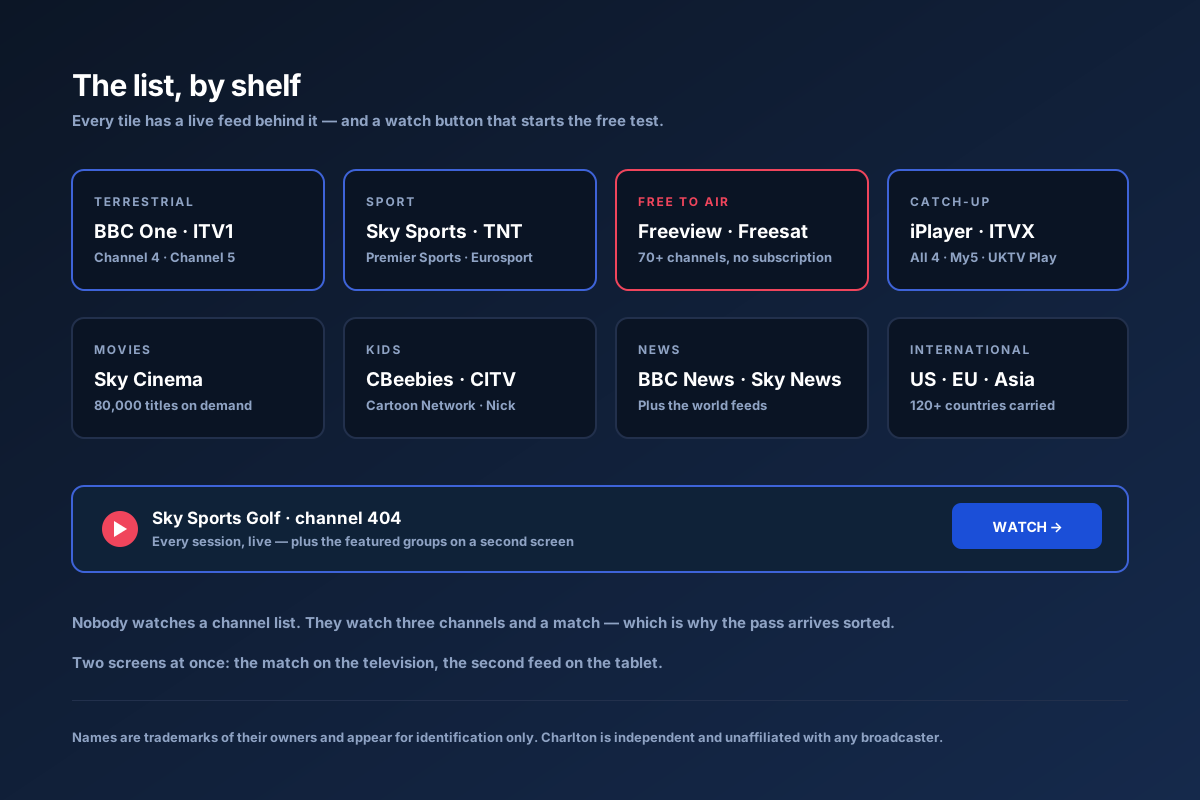
The main five are all there
BBC One, BBC Two, ITV1, Channel 4, Channel 5. Two providers were missing one of them, which sounds trivial until you want it on a Sunday.
Stability at kick-off
The busiest ninety seconds of any week. Everything else is decoration if the picture dies when the teams come out.
Both football packages
Sky and TNT between them hold the season. A list with one of the two has solved half the problem and will not say so.
Guide data that tells the truth
Broadcast times are less forgiving than films: a guide wrong by half an hour is worse than no guide at all.
Support in minutes
One pre-sales question at 8pm, one genuine fault during a match. Anything over an hour in the evening is a warning.
Pricing that survives checkout
Standard rate printed beside the promotion, no fee at the basket, no renewal on a card you must remember to cancel.
Three things that surprised us
Saturday 3pm is not the peak — Sunday 4:30 is
The blackout means the Saturday afternoon load is spread across commentary and results services. The genuine surge is Sunday at half past four, when two live matches, a full house and nothing else to do arrive at once. Three providers held Saturday and fell over on Sunday.
Guide accuracy exposed resold lists
The services with the worst guide data were also the least stable, and they were all reselling somebody else's playlist. A guide full of “No information” is a maintenance problem, not a cosmetic one.
Catch-up is the difference nobody advertises
Half the services carried a channel and could not offer its catch-up, which makes a six-part series unwatchable if you miss week three. Ask which channels have catch-up, and test one, before you pay.
How we score against our own criteria
Marked by us, published in full, weaknesses included — the free day exists so you can audit the marking.
Stability — 4.5 / 5
Twenty-six sessions, zero drops, two recoveries from source-side glitches. One drop during a Sunday match, restored in under a minute.
Coverage — 4.5 / 5
The main five, both football packages, the cricket, the golf and the film shelf. Not every niche channel in every region, and we say so.
Picture — 4 / 5
FHD baseline, verified UHD on selected sport. Not every channel, and we will not pretend otherwise.
Guide — 4.5 / 5
92% accuracy in our own audit; programme names occasionally lag a late schedule change.
Support — 5 / 5
Three-minute median in the evening, slower overnight — which is exactly when the boxing is on, so we are honest about the gap.
Pricing — 4.5 / 5
Promotional and standard rates together, no renewal, no fees. But the cheapest rate is a two-year bet.
Where we are weaker: UHD is limited to what was produced in UHD, catch-up is not universal across 40,000 channels, and this section is written by the people who benefit from its conclusion. The numbers are documented and the trial is free, but weight our score differently from our findings about everybody else.
Six steps that save the most money
List what the house watches
The main five and the football, or everything plus films plus the children? That answer picks the pass, not the price list.
Set a risk ceiling
The longest term you could lose entirely. Cheaper prices are bought with risk, never with magic.
Take a cardless trial
Full list, twenty-four hours, on the device you will actually use — not the laptop on the kitchen table.
Test at kick-off
Load the channel five minutes early and watch the first ten. That is where capacity shows.
Ask the awkward question
Which channels do you carry, where are your servers, and what happens when a route congests? Specific answers are the strongest signal in this market.
Read the footer, then pay
Company details, standard rate, renewal terms. Anything missing before payment will not appear afterwards.
Eight signals worth taking seriously
- A “free trial” that wants card details — the trial is a payment funnel with a countdown.
- Channel counts with no list and no way to search the catalogue before payment.
- No answer on the main five. If a provider cannot name them, the list is not maintained.
- No published server locations. If capacity is a secret, capacity is a problem.
- Support only by email, answered in days.
- No guide, or a guide full of “No information” — a resold file nobody maintains.
- A countdown timer that resets on every page load.
- “Lifetime” terms. Not a business model that can be honoured, only one that can be sold.
And one question that predicted our whole stability ranking: ask what happens when a route to their servers congests during a Sunday kick-off. A provider with an answer has thought about Saturday afternoon. A provider without one has thought about marketing.
The questions this guide always receives
What makes a good UK IPTV service?
Four things, in order: stability at kick-off, the channels your household actually watches, guide data that matches real broadcast times, and support that answers inside minutes. Channel counts are the easiest number to inflate and the least useful to compare.
What should it cost?
Between £9 and £20 a month on standard terms. Under £4 with no commitment usually means resold capacity or a short shelf life. Our £3.99 exists only because it is a 24-month prepayment of £95.76, with the £11.99 standard rate printed beside it.
How long does a test need to be?
Long enough to cover one real window — a Saturday 3pm, a Sunday 4:30pm, a midweek European night. Twenty-four hours on the full list is realistic; a demo channel is not a test.
Is there anything a subscription does not cover?
Yes: the TV Licence. Watching live television in the UK requires one whatever route the picture arrives by, and no provider can change that. A subscription covers delivery, not licensing.
Does a VPN make this legal abroad?
No. A VPN changes where your connection appears to come from; it does not change licensing, which is territorial by law. Our <a href="/articles/watch-uk-tv-abroad/">article on watching from abroad</a> says the same thing at greater length.
What happens if a provider disappears mid-term?
You lose what you prepaid, which is why term length is a risk decision rather than only a price decision. Never prepay further than you could afford to write off.
Six weeks of testing, twenty-four hours to check us
The method is above and the trial costs nothing — full list, UHD feeds included. Run it through one Saturday and see whether our own score survives your living room.
Get my free 24-hour test