British television, in the order you actually have to understand it
Five ways to receive it, five players to catch up on it, and one licence that covers the live part. Once you have those three sentences, the market stops being confusing.
Five routes into the same living room swipe →
| Route | What it is | What it costs | What it misses |
|---|---|---|---|
| Freeview | Aerial, one-off box or a smart TV tuner | Free — plus the licence | Most sport, most films |
| Freesat | Satellite dish, no subscription | Free — plus the licence | Same gaps as Freeview, different channel numbers |
| Sky | Dish and box, or Sky Glass over broadband | £25–£95 a month depending on tiers | Nothing much, which is the point — and the bill |
| Virgin Media | Cable, roughly half the country | £30–£90 a month with broadband | Availability; and the contract length |
| NOW | Sky's content, streamed, no dish | £10–£35 a month, cancellable monthly | The recorder, and some of the box-only features |
Prices are the publicly listed ranges in November 2026 and move every spring. The licence is separate from all of them and applies to live television however it arrives — aerial, satellite, cable or stream.
Free to air, pay, and the bit in between
Free to air
The main five, the digital spin-offs, the news channels, and a long tail of music and shopping. Paid for by the licence fee or by advertising, and free at the point of watching.
Pay
Sky, Virgin, TNT Sports, Premier Sports, the cinema channels. Sold in tiers, bundled with broadband, and usually tied to a contract of eighteen months or two years.
The bit in between
NOW, Discovery+, the paid tier of ITVX and the ad-free tiers of the players. Monthly, cancellable, and increasingly where the sport you actually want has ended up.
Five catch-up players, five logins
iPlayer, ITVX, Channel 4, My5 and UKTV Play. Between them they hold the last thirty days of British television, and between them they want five accounts, five privacy policies and — in ITVX's case — a nudge towards a paid tier every time you open it. iPlayer additionally requires a TV Licence declaration, which is the only place in the system where the licensing rule is enforced by a checkbox.
The catch is that catch-up rights are not broadcast rights. A channel can hold the right to show a programme live and not the right to keep it available afterwards, and a co-production can sit on one player and not another. That is why the same episode is on iPlayer for a month, on ITVX for a week and nowhere at all on the third platform. It is not a bug; it is a contract.
Which is the argument for a list with catch-up on the channels themselves: the programme is where you left it, seven days back, in the same place you watch live. It will never cover all 40,000 channels — nobody's does — but on the UK shelf it turns "we missed it" into "we will watch it tomorrow".
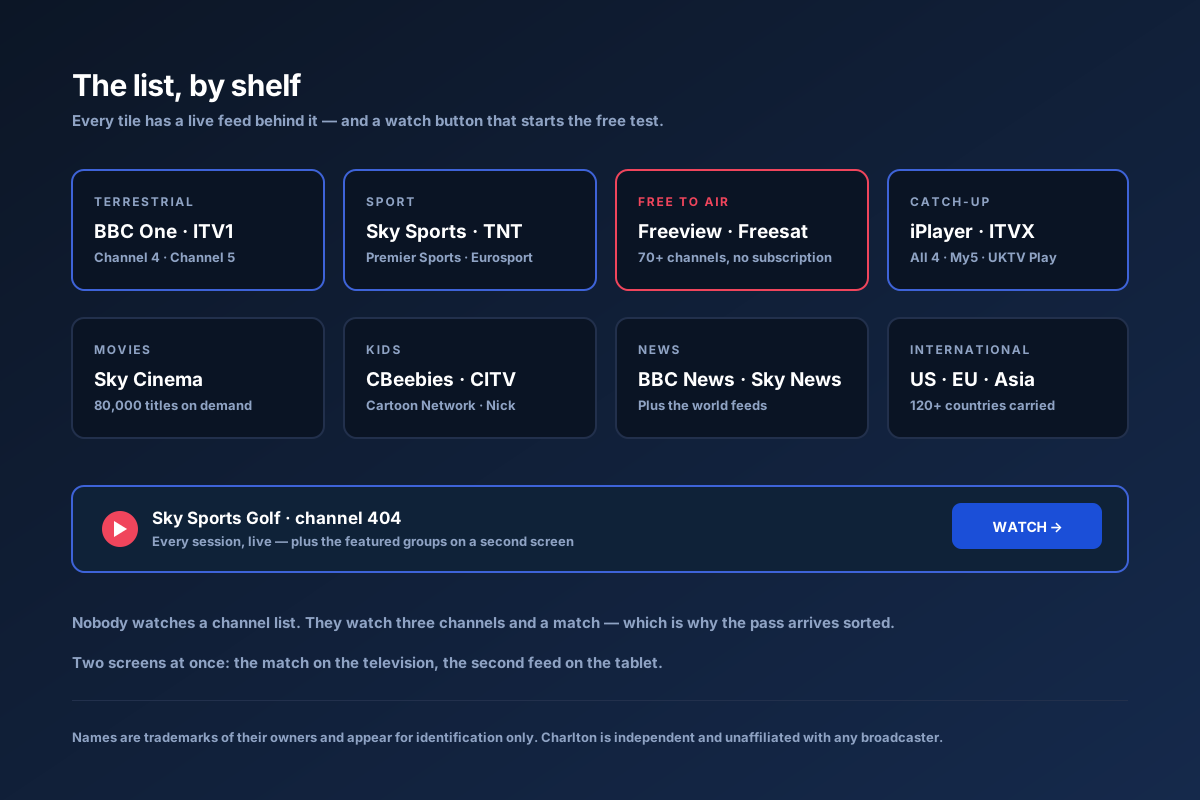
Why British television is expensive and still feels thin
A household with a licence, a pay-TV bundle and two streaming apps is paying somewhere between £90 and £150 a month and still cannot watch the away leg on a Tuesday without buying something else. That is not a failure of technology. It is a rights market that sells the same audience to four different companies in four different packages, and it has been that way since the Premier League first split its packages in 1992.
What an independent list does about it is arithmetic rather than magic: one subscription that carries the UK shelf, the sports channels behind it and the international feeds, at a price that reflects a 24-month prepayment rather than a monthly contract. It does not hold any rights, it cannot promise a channel will exist in three years, and it is not a substitute for a TV Licence. What it can do is stop a household paying four companies for one evening's viewing.
That is the whole pitch, and it is why the test is free: if the shelf is not what you hoped, you have lost an evening rather than a year. The buyer's guide is the sceptical version of this argument, including the parts that do not flatter us.
The questions people actually ask
What is the difference between Freeview, Freesat and Sky?
Freeview comes down an aerial, Freesat down a satellite dish, and both are free to watch once you have the box. Sky is the pay version of the satellite route — and NOW is the same content streamed, with no dish at all. Virgin Media is the cable alternative, available in roughly half the country.
Do I need a TV Licence?
To watch any live broadcast in the UK, yes — including live television streamed over the internet, and anything on BBC iPlayer. It is roughly £175 a year, per household, and it is a legal requirement rather than a subscription. Check the current figure on tvlicensing.co.uk.
Why is a programme on iPlayer but not on my television?
Because catch-up rights and broadcast rights are sold separately. A channel can hold the right to show something live and not the right to keep it on a player, and a player can hold rights for a limited window. It is the single most confusing thing about British television, and it is not a technical fault.
Is a Firestick enough to watch British telly?
For streaming, yes — the iPlayer, ITVX, Channel 4 and My5 apps all run on one, along with the apps for the pay services. It will not receive Freeview over an aerial, but if everything you watch is streamed, it is the cheapest complete answer.
One list instead of five logins
£3.99 a month on the 24-month pass, two screens, and a free day to see whether the shelf suits the house.
Get my free 24-hour test